The August 11, 1999 Total Solar Eclipse

On August 11, 1999, a total solar eclipse occurred in central Europe, the Middle East, and India. A partial eclipse was visible from the north-eastern US, Europe, north Africa, and west Asia. On July 28, 1999, we performed an MHD computation of the solar corona to predict what the solar corona would look like during the eclipse. We used photospheric magnetic field data from Carrington rotation 1951 (corresponding to the dates June 24 – July 21, 1999) from the National Solar Observatory at Kitt Peak. Our prediction was published on this web page prior to the eclipse. Below we compare our prediction with two images of the eclipse.
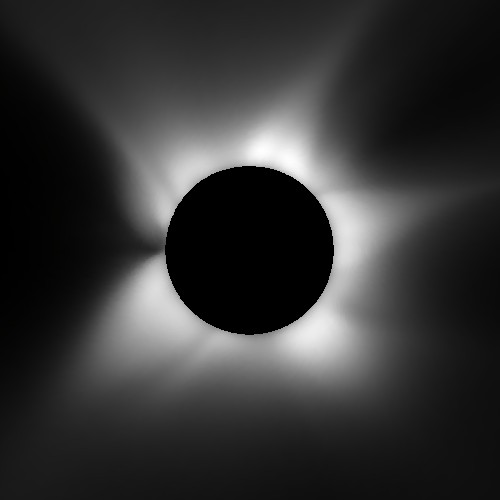
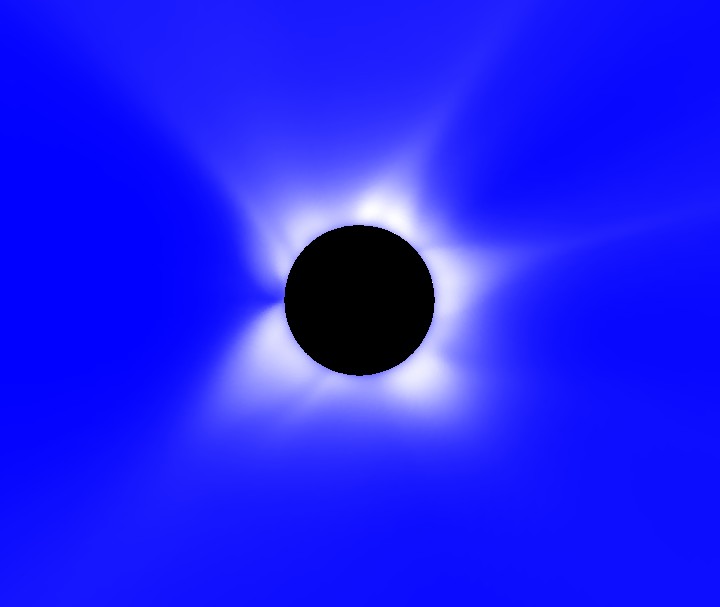
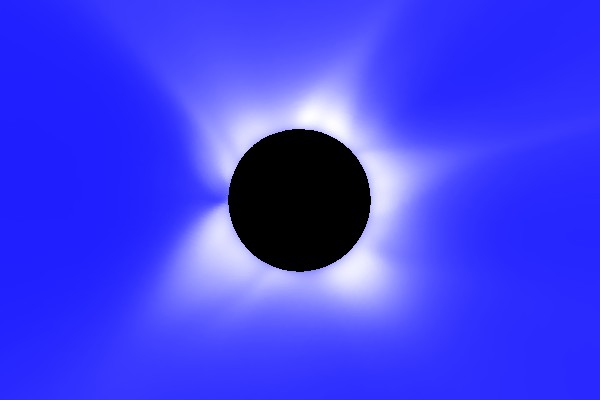
Predicted polarization brightness (pB) in the solar corona for August 11, 1999, at 11:38 UT (corresponding to totality in eastern Turkey). The state of the solar corona was computed using a 3-D magnetohydrodynamic (MHD) simulation. The pB signal is produced by white light scattered off electrons in the coronal plasma. The image has been radially detrended to account for the fall-off of coronal brightness with distance from the Sun. Vertical (top) is terrestrial (geocentric) north. This is the view of the Sun that would be seen by an observer on Earth with a camera aligned so that vertical is toward the Earth’s north pole. Views aligned with solar north are on the original solar-north page.
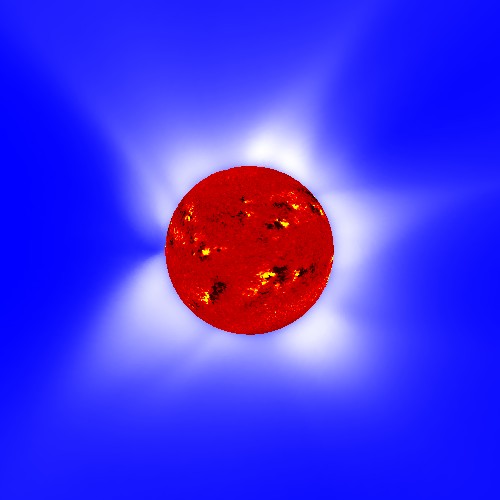
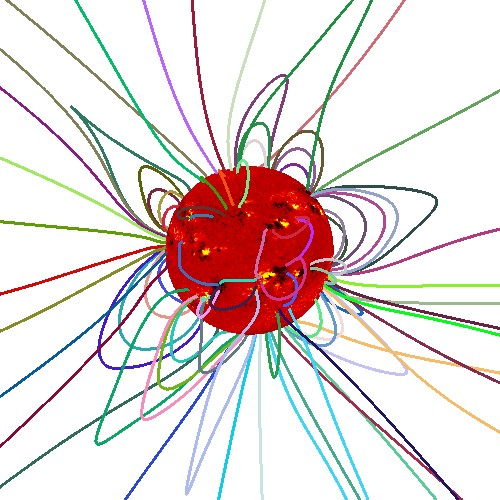
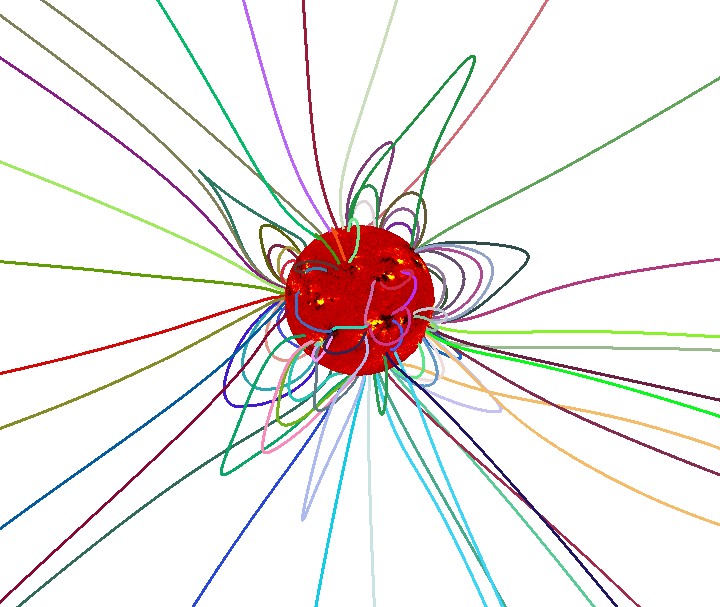
Predicted polarization brightness (left) together with traces of the magnetic field lines (right), in the solar corona, also for August 11, 1999, at 11:38 UT. The Sun’s surface shows color contours of the radial component of the measured photospheric magnetic field from Kitt Peak National Solar Observatory, showing the location of active regions (strong magnetic fields).
Comparison with an Eclipse Photograph Taken in Romania
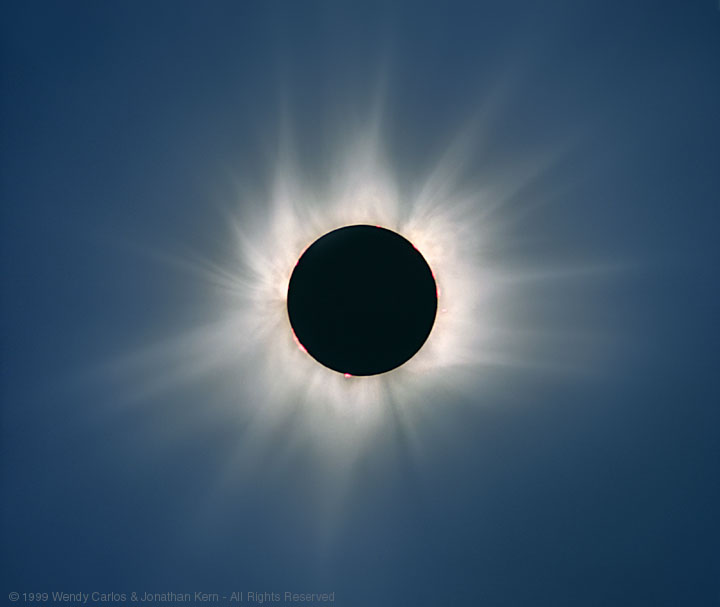
Image from Romania(courtesy of Wendy Carlos*)
MHD Model PredictionPolarization Brightness
MHD Model PredictionMagnetic Field Lines
In the figures above we compare our MHD model prediction with a photograph taken in Romania. The eclipse image is a computer composite and optimization from five negatives taken with radially graded filters by Wendy Carlos and Jonathan Kern. The images have terrestrial (geocentric) north vertically upward. *Eclipse Image: © 1996–2000 Wendy Carlos – All Rights Reserved. For details, see wendycarlos.com/eclipse.html.
Comparison with an Eclipse Image Taken in Turkey
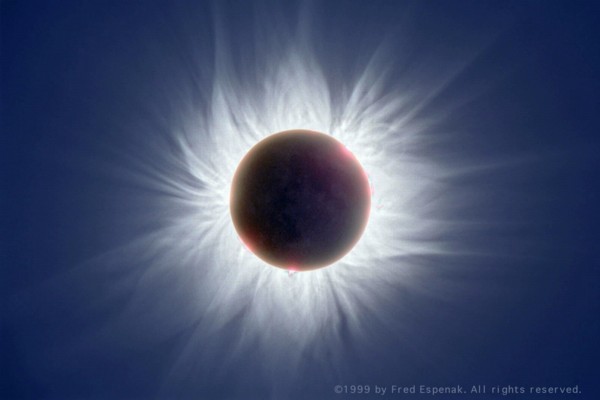
Image from Turkey(courtesy of Fred Espenak*)
MHD Model PredictionPolarization Brightness
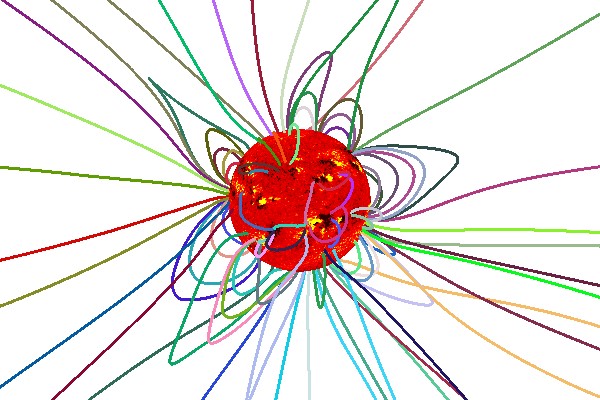
MHD Model PredictionMagnetic Field Lines
In the figures above we compare our MHD model prediction with a photograph taken in Turkey. The eclipse image was constructed by adding 22 separate photographs taken at different exposures to compensate for the rapid radial fall-off of the brightness in the corona, and was digitally processed to enhance the fine details of the corona. The images have terrestrial (geocentric) north vertically upward. *Eclipse Image: © 1999 by Fred Espenak, courtesy of MrEclipse.com.
A Comment About the Accuracy of the Predictions
It can be noted from the comparisons above that the prediction at this time when the Sun is very active (during the ascending phase of the solar cycle close to solar maximum) is not as accurate as our previous predictions at solar minimum. This may be due to several reasons, including the fact that the Sun’s magnetic field was changing rapidly at this time. It would therefore be expected that using out-of-date magnetic fields to predict coronal structure would be less accurate. In addition, the limited spatial resolution of our calculation would be more limiting at this time when the coronal magnetic field is very complex. In the future we will be able to perform higher resolution calculations on massively parallel computers. Finally, measurements of the transverse magnetic field in the photosphere may be important to get a more accurate estimate of the magnetic field in the corona. This may especially affect the non-radial inclination of streamers seen in the eclipse images above. Note that an effort was under way at the National Solar Observatory at Kitt Peak (the SOLIS project) to measure the transverse magnetic field.
Animation of the Entire Eclipse
Here we have combined our predicted structure of the solar corona during the eclipse with a simple animation of the Moon’s motion across the solar disk to show the eclipse as it would be seen by an observer in central Turkey. It is a combination of simple celestial mechanics with the polarized brightness image shown above.
Eclipse Animation(view from central Turkey)
Evolution of the Photospheric Magnetic Field
The photospheric magnetic field maps we use for our calculations are built up from daily observations of the Sun during a solar rotation. These maps give a good approximation of the Sun’s magnetic flux if the large-scale flux is not changing much throughout a rotation. Previously, we have computed coronal models for an eclipse during the declining phase of the last solar cycle (November 3, 1994), for two eclipses during solar minimum (October 24, 1995 and March 9, 1997), and one eclipse during the early rising phase of the new solar cycle (February 26, 1998). The August 11, 1999 eclipse, which occurred as we began to approach solar maximum, presented new challenges. The photospheric magnetic field was evolving more rapidly, making synoptic magnetic field data a less reliable approximation to the true state of the photospheric magnetic field. The increased complexity of coronal structures also required higher resolution runs (~2,000,000 grid points) than in our previous computations (~650,000 grid points).
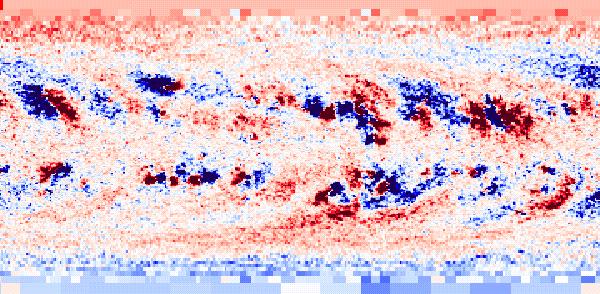
CR1949 (May 1 – May 28, 1999)
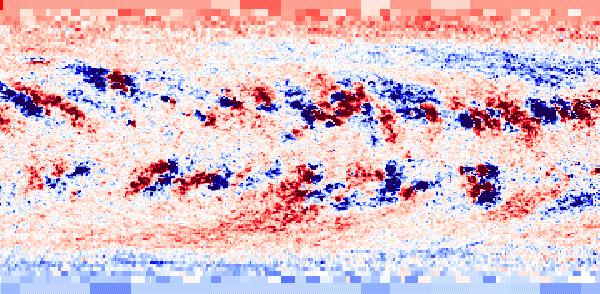
CR1950 (May 28 – June 24, 1999)
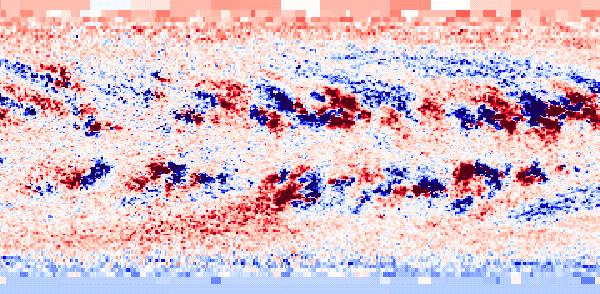
CR1951 (June 24 – July 21, 1999)
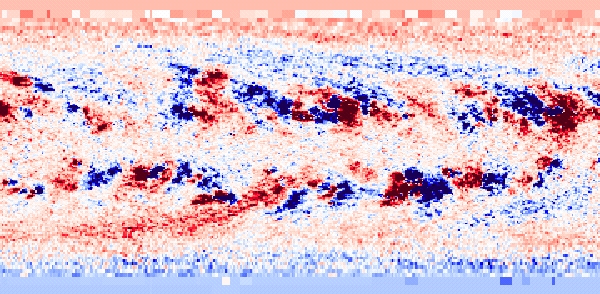
CR1952 (July 21 – August 18, 1999)
Photospheric magnetic field maps for four Carrington rotations leading up to the eclipse, CR1949, CR1950, CR1951, and CR1952, as measured by the National Solar Observatory at Kitt Peak. The maps show the measured photospheric field as a function of latitude (vertical axis) and Carrington longitude (horizontal axis). Red shows outward directed magnetic flux, and blue shows inward directed flux. These maps are considerably more complex than maps during solar minimum.
Movies
We have made a movie of the polarization brightness from our MHD simulation of the solar corona during Carrington rotation 1951 (June 24 – July 21, 1999). This gives a visual impression of how rapidly the solar corona changes as a result of solar rotation during the maximum phase of the solar cycle.
Polarization Brightness(Carrington Rotation 1951)
Other Web Resources for the Eclipse
- Fred Espenak’s web site at Goddard Space Flight Center – a great resource for the eclipse.
- Eclipse information from NASA’s Goddard Space Flight Center.
- Sky and Telescope Magazine – general information on eclipses.
- SOHO and the eclipse – SOHO’s support for eclipse expeditions and realtime images.
Archived prediction, converted from the original 1999 page. Movies originally offered as MPEG/QuickTime/AVI downloads are embedded above.