The October 24, 1995 Total Solar Eclipse
On October 5, 1995, we made a theoretical prediction of what the solar corona would look like during the total solar eclipse of October 24, 1995. Our prediction is shown here, along with an eclipse image for comparison. More ground-based eclipse-day images can be found at Mauna Loa Solar Observatory.
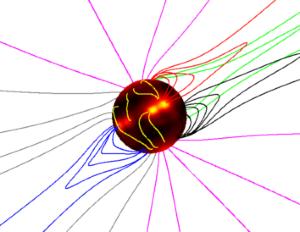
Traces of the magnetic field lines, in arbitrary colors, in the solar corona from a 3D numerical calculation of the solar corona for Carrington rotation 1900 (the rotation prior to the eclipse). The photospheric magnetic field data was obtained from Wilcox Solar Observatory (special thanks to Todd Hoeksema for providing us with the data as soon as it was available). The view corresponds to the approximate time of the eclipse (Carrington longitude of 39 degrees). Note the double streamer structure on the west limb. The image in the photosphere shows the intensity of the magnetic field; active regions with strong magnetic fields appear yellow.
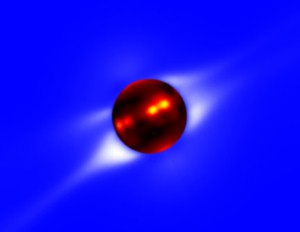
Simulated eclipse image generated from the same calculation described above. The image shows the predicted polarization brightness (white light scattered off the electrons) in the solar corona for October 24, 1995 at 05:00 UT. This quantity is commonly observed using coronagraphs, such as the Mark 3 Coronameter at Mauna Loa Solar Observatory, and during eclipses. The bright structures that are visible are known as helmet streamers. The image has been radially detrended to account for the fall-off of coronal brightness with distance from the Sun. The image has also been rotated so that geocentric north points up; heliocentric north is 25 degrees to the left of vertical. A gray-scale image is also available.
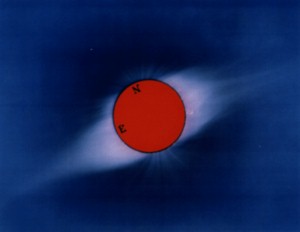
An eclipse image taken by F. Diego of University College, London, and kindly provided to us by S. Koutchmy of Institut d’Astrophysique, Paris, CNRS. Note that a double streamer is indeed present on the west limb, but the rays above the helmet are strongly nonradial.
Archived prediction, converted from the original 1995 page.