What's New
For 2026, we again employ a data-assimilative, continuously running prediction model updated in near real time, as described by Downs et al. (2025). To drive the time-evolving model, we assimilate photospheric magnetic field data from the HMI instrument aboard SDO into the High performance Flux Transport (HipFT) surface flux transport model to produce full-Sun maps that approximate the state of the solar surface magnetic field as a function of time. This sequence of maps is used to drive the Magnetohydrodynamic Algorithm outside a Sphere (MAS) time-dependent coronal and heliospheric models. As in 2024, we show a continuously updated prediction of the coronal appearance in white light for eclipse day, along with simulated EUV imaging for SDO AIA, and coronal imaging for STEREO COR2, SOHO LASCO C2, and Solar Orbiter Metis.
Exciting New Advances
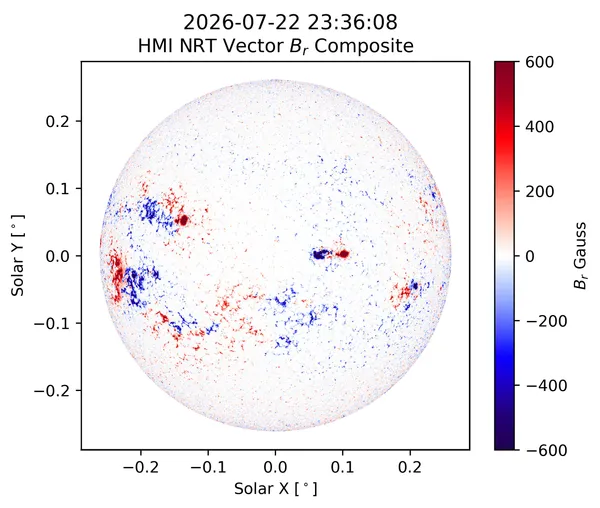
We assimilate HMI Vector magnetograms in near-real time. We infer the radial field (Br) by combining vector data in strong field regions with line-of-sight data in weaker field regions
We perform surface flux transport calculations at the highest resolution ever (4096 X 2048) with HipFT
We model the solar corona and inner heliosphere from the solar surface to 1 AU, providing instantaneous magnetic connectivity maps for in situ spacecraft at L1, Parker Solar Probe, STEREO, and Solar Orbiter
We show simulated heliospheric imaging for PUNCH, SoloHI aboard Solar Orbiter, SECCHI/HI-1 aboard STEREO, and WISPR aboard Parker Solar Probe
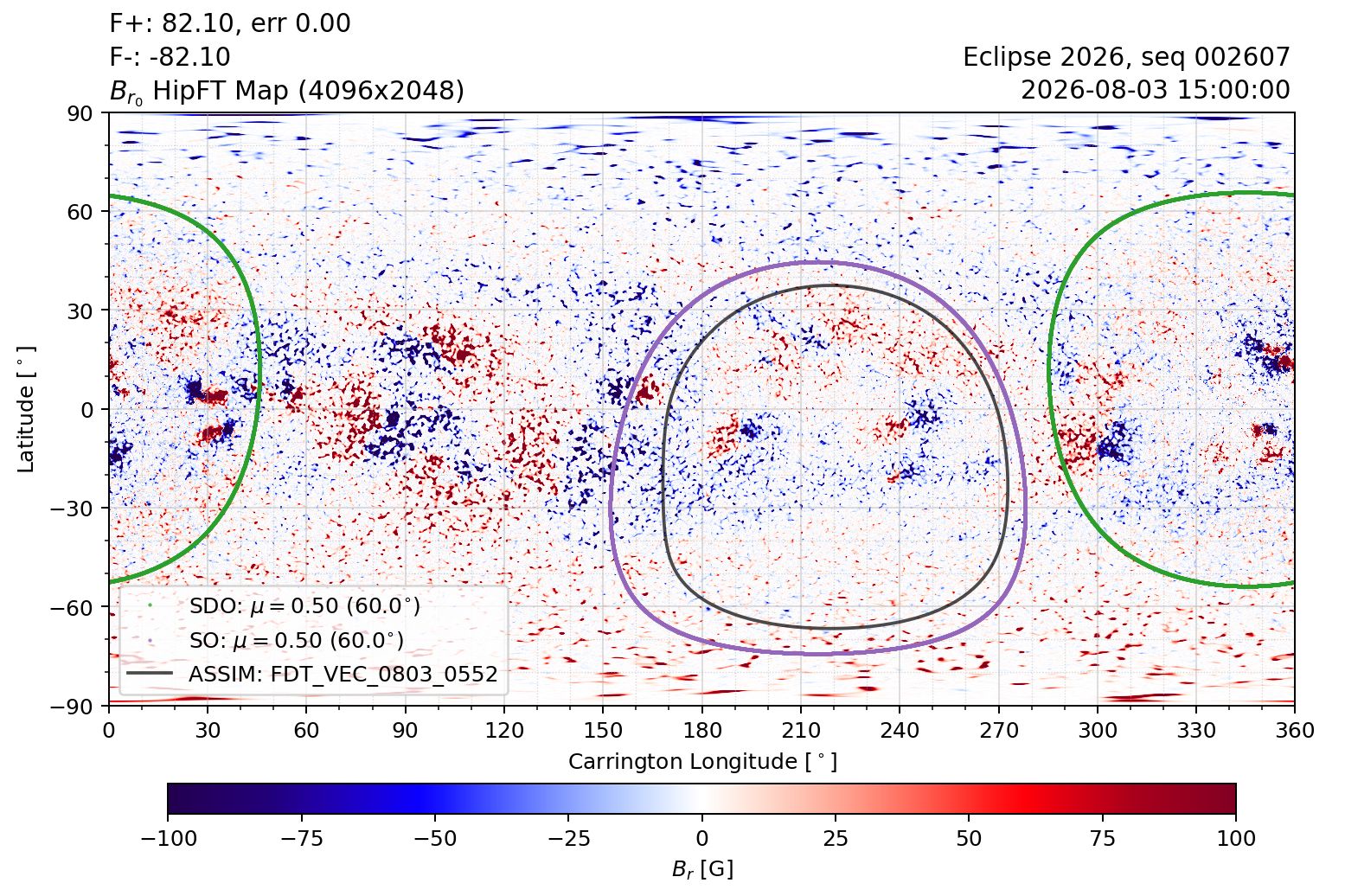
Beginning August 1, we assimilate photospheric magnetograms viewed from the far side of the Sun (opposite Earth) obtained from the Solar Orbiter PHI instrument. Solar Orbiter's view will be near the east limb of the Sun (as viewed from Earth) on eclipse day.
We now compute simulated coronal imaging for the Proba-3/ASPIICS coronagraph
We developed a new polarity-coded Q render that highlights the spatial relationship and dynamic interplay between closed and open fields.